

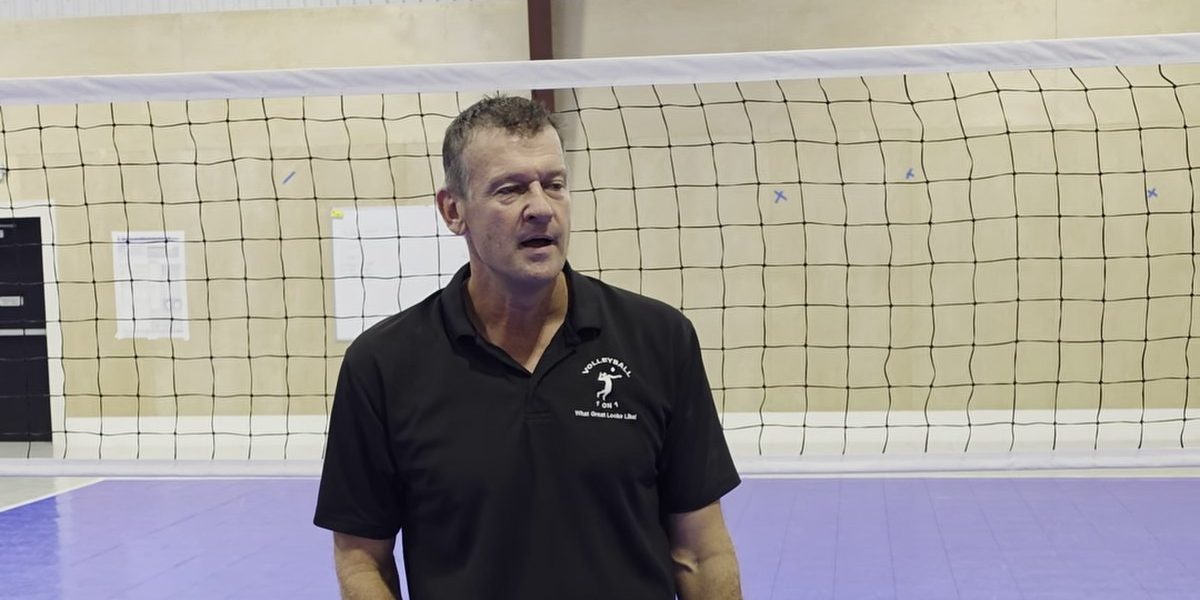
If you have elbow pain when spiking volleyball, look at how you pull your arm back before you do anything else. A lot of players are now being taught to drop the elbow low to protect the shoulder, and I am seeing kids with major elbow problems from it. I think the fix is a fast load with a high elbow: through the track, not around it.
I am not a movement performance expert, and if something hurts, go see someone who is. But I have been coaching for 34 years, and what I am hearing from players frustrates me enough that I knocked out this quick video.
What I keep hearing from players
I keep seeing people talk about how we now need to start pulling our elbow down low in order to spike, so we can protect our shoulder. What I am hearing is that it is putting a lot of strain on players’ elbows. Instead of shoulder injuries, I am hearing about elbow injuries.
I spoke to a kid last night. I spoke to another kid two months ago. I am hearing about all these kids having major elbow problems because of the way they are pulling.
I never saw this at UCLA
I played at UCLA, where I won two NCAA national championships, for a very long time. Maybe it was old school, but I never saw an elbow injury in my entire time there. Not once.
Now I am seeing all these kids hurting their elbows. And everyone says, well, it’s because they play more. No. Then they say, well, it’s because they are hitting harder. No. When I was in college, I could hit a ball that bounced over the wall and came back over the service line. Hitting hard is not new.
A baseball motion does not fit a volleyball swing
As I see it, the low elbow pull comes out of baseball: a throwing motion imported into volleyball. But I don’t think the two motions are comparable. A pitcher is on the ground, with time and a full chain to transfer force through. A hitter is in the air, without any of that.
So when you start bringing your elbow from down low, you have to come all the way from there, and then convert that power into your swing, in the air, in very little time. That is the part I want people to talk about. Everyone asks whether you are going to hurt your shoulder. There is not enough conversation about what is happening at the elbow.
Late pulls make it worse. If the arm is not loaded and the player is still trying to transfer from down low to up high as she swings, that is when I hear about these injuries.
Through the track, not around it
You don’t need the low elbow to hit hard. If you can create a big gap with a high elbow, you can hit just as hard.
The question I ask is simple. Is it faster and easier for a kid to go through the track, with a fast load, a big wide gap, easy, lots of power? Or to load from down low, then try to convert that into a swing, and hurt the elbow? For me, it is not close.
Here is what to look for in your own swing:
- Lead with the wrist. The wrist takes the arm back and up. Nothing has to switch in the middle of the swing.
- Load fast. The arm should be back and ready early, not still traveling when the swing starts.
- Keep the elbow high. That gives you the big gap between your elbow and your hip.
- Go through, not around. If you can see the arm circle out and down, it is taking the long way.
For the rest of that motion, see Volleyball Arm Swing Mechanics.
If you coach or have a player with a sore elbow
Start by watching the pull, on film if you can. Is the elbow low? Is the arm late? Then ask who taught it and why. A player changing her arm swing to protect her shoulder should know what it might cost her somewhere else.
And if she already has pain, get it looked at. A coaching opinion is not a diagnosis. This is a conversation about technique, and I want more of it. I went into much more detail with an injury specialist in this older article on how spiking technique gets taught.
The takeaway
If you are old school like me and you want to teach this way, I am a big fan of the track: fast load, big wide gap, wrist leading, elbow high. It is simple, it has plenty of power, and I never saw these elbow problems in my time at UCLA.
Coaches can find the full arm swing in the Volleyball1on1 Coaching Manual.