
If your daughter is struggling to pass, look at her legs before you look at her arms. In volleyball, and especially in women’s volleyball, a good volleyball passing stance starts with being able to perform a proper squat. When a player cannot do that, no amount of work on her arms will fix it. Her passing problem is a squat problem.
The squat is where I start in the weight room, and every movement pattern I teach after it is built on it. In 34 years of coaching I have watched a lot of young players try to pass without bending their legs. The video shows how we fix that.
What I see in a lot of girls
When you look at a lot of girls in a gym, they literally cannot bend their legs. They stay tall and try to pass with their arms. What they need to learn is to move their butt back and create space between their passing platform and their legs. That space is what lets a passer make corrections. Without it, her knees and her arms are fighting for the same spot.
The arms get all the attention because they touch the ball. But the ball only knows angles, and the angle of the platform depends on what the legs underneath it are doing. A player who cannot bend her legs has nowhere to go when the serve moves. She reaches with her arms, the angle changes, and the ball goes somewhere she did not want it to go.
This is not a talent problem. It is a strength and movement problem, and it can be trained. A lot of girls just don’t have the strength or the correct movement pattern to pass correctly yet. That is the good news for parents. Lifting is not like volleyball skills. If a player lifts consistently, she will see results over time.
Start with a box
For some players, we actually start with a box. The player stands in front of it, sits down onto the box, and stands back up. You can see in the video how they sit down on the box. The box teaches the body the correct movement: the hips hinge, the knees stay behind the ankles, and the butt goes behind the knees.
Younger players cannot process everything at once. If you tell a young player to pass the ball, you are asking her to read the serve, move her feet, set her platform and bend her legs all at the same moment. When we pull out one part of the skill and train it without a ball, we can often change a bad habit. Once she can do the part, we move her back into the whole skill, as game-like as we can make it.
The basic squat with a medicine ball
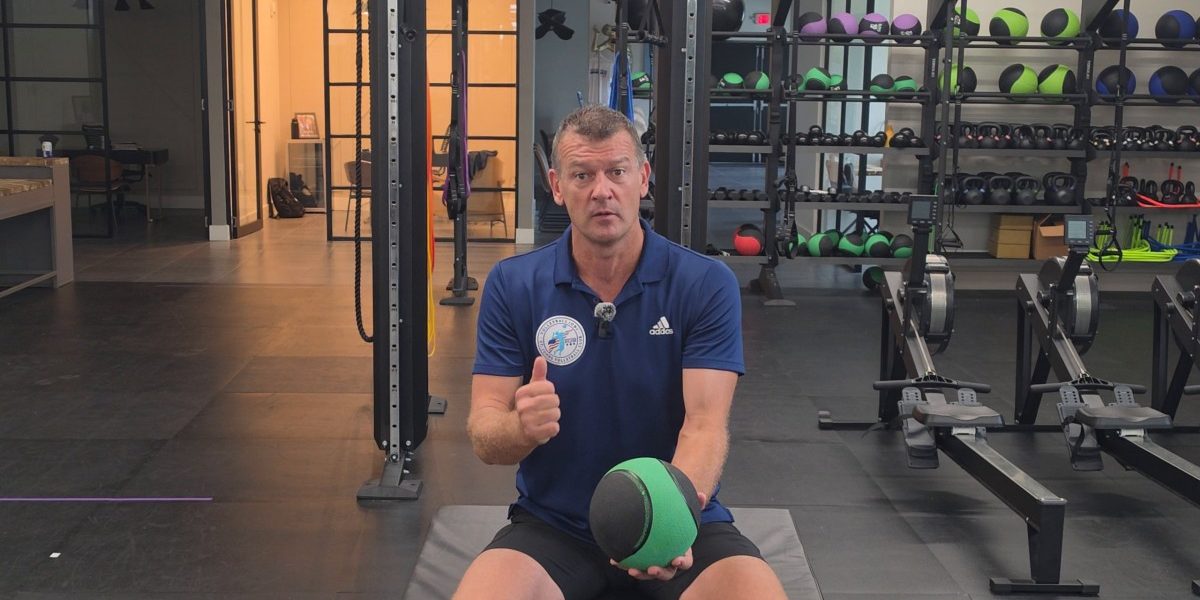
Once the players become a little bit more advanced, we take the box away and go into a basic squat. In the video I am holding a medicine ball out in front of me, like I am passing, and I am sticking my butt out behind me. The arms stay out and away from the body, the way they would be in serve receive. We use a medicine ball so players are holding it and learning the movement pattern at the same time.
The important things to think about come on the way up. As you are coming up, squeeze your glutes. And you are really learning how to create that space between the platform and the legs, rep after rep, until that is simply the way you stand to pass.
Slow down, faster up
The rhythm of the squat matters. Slow down, faster up. Lower yourself under control, then come up with speed.
That second half is not an accident. When a passer has to get off the floor and attack, the same move out of the squat is what starts her arm swing. Teaching players to come out of a pass and get explosive starts right here, with a squat that goes down slowly and comes up fast.
What a good volleyball passing stance looks like
When the squat starts to feel natural, we take it back to the court:
- Correct hip hinge. Knees behind the ankles, butt behind the knees.
- Wide base, strong legs. A solid base gives the platform something to stand on.
- Weight balanced through your midline. Good passers focus on balance.
- Arms out and straight. Keep a gap between your platform and your body so you have room to adjust.
- Only move up. No up and down through the pass.
The arms and hands have their own cues. I go through those in How to Pass a Volleyball.
A note for parents
Many parents and coaches overlook the physical side of volleyball. They see a passing problem and ask for more passing reps. Reps matter. But if your daughter does not have the strength to sit into her stance and hold it, more reps will repeat the same fault.
Physical training is also something a player controls. She cannot control the serve, the referee or the other team. She can control whether she does her squats. That makes it a powerful motivator, because she can see herself getting stronger.
The takeaway
Look at her legs first. Can she sit into a proper squat, butt back, knees behind her ankles, with space between her platform and her legs? If she can’t, that is where the work starts. A box, then a basic squat with a ball held out in front, slow down and faster up.
For a story about what happens when a passer’s technique gets rebuilt at the wrong moment, read Tryout Advice – Thanks, But No Thanks. Coaches can find the full progression in the Volleyball1on1 Coaching Manual. I am a two-time NCAA national champion at UCLA, and if you live near St. Augustine, Florida, you can come see us at a tryout.