
The volleyball wrist snap is the end of the whip. If you think about a whip, the end of it when spiking is your ability to come in and snap hard. Hips for power, and the arm is the whip. If the end of the whip is slow, the snap is slow, and you can train it directly with no ball and no equipment.
The drill in this video is one of the funny-looking things you can practice, and it really helps you hit harder. I have seen people watch it and go, “Oh my God, really?” But yeah, it works.
Why a slow wrist steals your power
Spiking works like a whip. The power starts in your hips and your core, the body weight transfers through the swing, and it comes out at the wrist.
A lot of people don’t have a lot of mobility in their wrists. So when they try to transfer all that body weight transfer, the hips for power and the core, into a snap, the snap is not fast, because the wrist just doesn’t go fast.
Think about what that means. A player can have a good approach and a big swing and still not snap fast. So one of the things you can do is work on it directly. How fast can I get my snap? Snap, snap, high snap.
A volleyball wrist snap drill with no ball
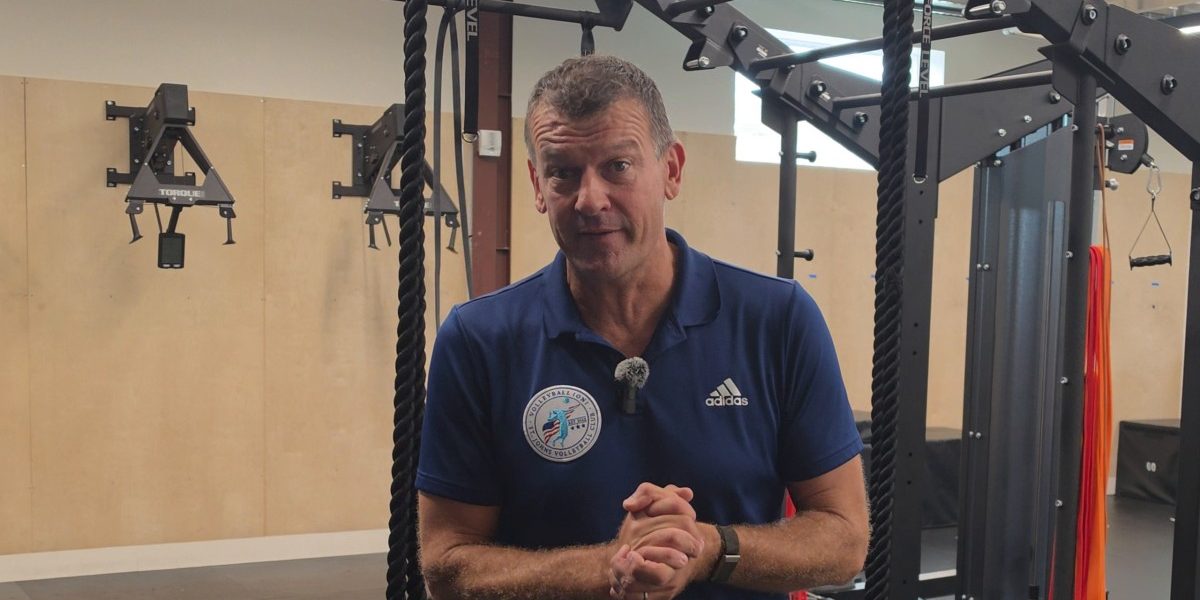
In the video, there is no ball. I put my hitting hand up high, where I would contact the ball, and I snap the wrist forward, fast, over and over.
- Get the hand up high, above your head, at your contact point.
- Keep the arm high. The hitting arm is vertical, reaching to its high point.
- Snap the wrist forward fast.
- Bring it back and snap again: snap, snap, high snap.
- Stay focused on speed, not force.
You can see it in the video. It looks a little funny. But you are training the wrist to be mobile and fast, and that is exactly what the end of the whip needs.
Put it back into the arm swing
The snap only helps if it shows up in your swing. In our arm swing, the loaded position is arm at 90 degrees, wrist back. Then the hips start, the elbow comes through high, and the wrist snaps. In my coaching manual, that is the loaded snap: hips, elbow high, wrist snap.
From there, we take it to the wall. Twenty wall hits with wrist snaps, or partner hits, with a high two-handed toss. The two-handed toss is very important.
In the attack itself, the shoulders are slightly angled so the hitting arm is higher, and the non-hitting arm drives forward and comes to the chest. The snap happens at the high point, which is why we train it with the hand up high. I walk through the rest of that swing in Volleyball Arm Swing Mechanics.
The wrist leads the load, too
The wrist is not only the finish. It also leads the arm into the loaded position. When the arms first go back, the coaching point is to turn your wrist. In the load, the wrist goes up over your head first, and the pull stays short.
So a hitter’s wrist has two jobs: lead the arm back fast, and snap fast at the high point. Both need a wrist that moves.
What it looks like when it works
If you ever see someone practicing this, be careful. They might just really crush balls.
That is the payoff. A fast wrist lets a player turn all of that body weight transfer into a snap that is fast. The band drill in How to Hit a Volleyball Harder trains the arm to go fast. This one trains the very last part of it.
A note for parents
If your daughter has a good approach and a big swing but the ball comes off her hand soft, watch her wrist at contact. Is it snapping, or is it stiff? This drill takes no equipment and she can do it anywhere. It looks funny, but it works.
The takeaway
Spiking hard is easy if you know what to do right. Hips for power, and the arm is the whip. The volleyball wrist snap is the end of that whip, and if the wrist is slow, the power never reaches the ball. Hand up high, snap, snap, high snap. Then take it to the wall and into the swing.
I am a two-time NCAA national champion at UCLA with 34 years of coaching, and coaches can find the loaded snap and the wall work in the Volleyball1on1 Coaching Manual.