
Good volleyball arm swing mechanics start with something a lot of players are not doing: getting the arm back all the way. Come out of your squat, open up, get all the way back, load and throw. That simple pattern is about full power and full body extension, and it is how young players learn to become explosive.
It opens up their body so they can spike harder and jump higher, and it teaches them to come out of a pass and get explosive. I have been coaching for 34 years, and it is a very simple pattern. The video shows it with a medicine ball.
Why so many hitters swing with half an arm
A lot of players are actually not getting their arm back all the way. If the arm is not back, there is nothing to load, and load and throw is the whole pattern. Full power needs a full arm.
The explosion of coming through the ball depends on what happens before it. Developing good movement patterns as you are coming over your head, and trying to get into a high contact point, are critical for young players. If the arm is not back, neither one happens.
Build it on the squat and the side lunge
I like to build this movement pattern after the squat and the side lunge. A player should already be able to sit into a good squat and lunge sideways with her knees back before we ask her to load and throw out of it. The squat is in Volleyball Passing Stance.
There are two ways we put it together. The first way follows the squat. You do a basic pass, come up fast, load, snap and go. The second way adds the lunge. It would be squat, lunge, lunge, come up, load and go.
Either way, the movement starts low, in a passing position, and finishes high, at full extension. That is the point. In a match, a player passes, and then she has to get up and get explosive to attack. This pattern trains that transition.
How load and throw works
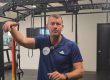
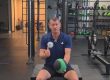
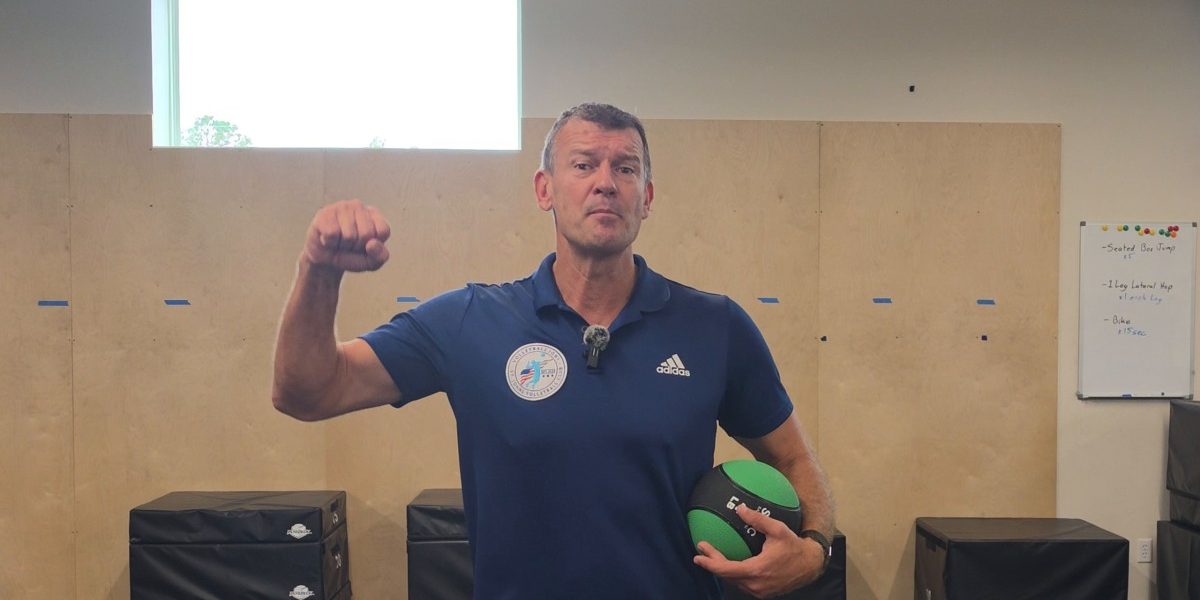
In the video I use a medicine ball. I hold it in my hitting hand and take it back behind my head into the loaded position, then come through the throwing motion. The ball gives players something to hold while they learn the pattern.
- Come out of your squat. Up fast, with the legs doing the work.
- Open up. The hips and shoulders turn so the hitting side can go back.
- Get all the way back. Arm at 90 degrees, wrist back, elbow high.
- Load. The non-hitting arm stays up while the hitting arm pulls.
- Throw. The non-hitting arm drives forward, the hitting arm reaches high and comes through.
Really, really good for teaching players full power.
What the load should look like
We teach the arm swing in a five-part sequence, and you call it out loud: zero, one, two, three, four, five. Zero, the arms point down. One, the arms go back and you turn your wrist. Two, both arms reach high above the head. Three, the arms are loaded. Four, the attack. Five, the finish.
Load and throw lives in parts three and four. In the loaded position, the hitting arm leads with the wrist. Pull the wrist over your head, not back like a bow and arrow, and limit the distance of the pull. A high elbow gives you more range.
Then the attack. The non-hitting arm drives forward to create power and balance in the air, and it comes down to the chest. That matters, because a non-hitting arm that flies across the body pulls the attack into the block. The hitting arm goes vertical, reaching to its high point, and the finish comes down to the same leg.
Open the hips to generate power
Opening up is not just a shoulder move. The hips open to generate torque and power. When the hips open and then drive through, the body weight transfers into the swing, up through the shoulder, the elbow and the wrist.
Loading fast matters too. Loading fast helps reduce injury and increases range. Once the shape is right, we want the arm to get back quickly, and that is where speed work comes in. I show one way to train it in How to Hit a Volleyball Harder.
A note for parents
Explosive power is part of volleyball. Jumping to block and spike, getting up off the floor after a pass, coming through the ball: these are explosive movements, and they can be trained.
If your daughter’s swing looks short, watch her arm before contact. Is it all the way back, with the elbow high and the wrist back? If not, that is the piece to train, away from the ball first, then with it.
The takeaway
Full power needs a full arm. Come out of the squat, open up, get all the way back, load and throw. Build it on the squat and the side lunge so it starts from a passing position, and teach the five-part arm swing so the load is high, fast and led by the wrist. Then the explosion of coming through the ball has something behind it.
I am a two-time NCAA national champion at UCLA, and the arm swing is laid out part by part in the Volleyball1on1 Coaching Manual.